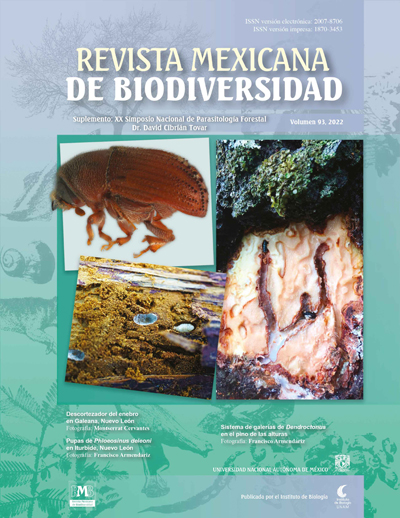


The spermatheca in the genus Dendroctonus (Curculionidae: Scolytinae): morphology, nomenclature, potential characters for taxonomic use and phylogenetic signal
DOI:
https://doi.org/10.22201/ib.20078706e.2022.93.4895Keywords:
Receptacle, Receptacle gland, Geometric morphometricsAbstract
In most members of the genus Dendroctonus, the usefulness of the spermatheca for taxonomic purposes has not been evaluated in depth; therefore, the aim of this study is to describe and compare the elements that integrate the female reproductive apparatus among Dendroctonus species, clarify their nomenclature and evaluate their interspecific
variation to propose useful characteristics for their identification. In addition, we evaluated whether there is a structure between the shape of the receptacle and the phylogenetic relatedness of the species. The spermatheca consists of a sperm duct, a receptacle, and a gland; of these elements, the receptacle is the most taxonomically informative structure. The most closely related species of the D. frontalis complex show wide intraspecific variation in the shape and size of this structure, which precludes recognition of diagnostic features. However, there are differences among
species groups in both shape and size in less closely related species such as D. approximatus, D. mexicanus, D. micans, D. parallelocollis and D. rhizophagus. A phylogenetic signal was detected in receptacle shape, and patterns
of morphological similarity and phylogenetic relatedness of species were evident in the D. frontalis complex.
References
Anderson, R. (1984). Connatzchela artemzszae, a new genus and species of weevil from the Yukon territory (Coleoptera: Curculionidae: Leptopiinae): taxonomy, paleontology, and biogeography. The Canandian Entomologist, 116, 1571–1580. https://doi.org/10.4039/Ent1161571-11
Armendáriz, F., García, J., López, M., Sullivan, B., & Zúñiga, G. (2017). New characters and redescription of Dendroctonus vitei (Coleoptera: Curculionidae: Scolytinae). The Canadian Entomologist, 149, 413–433. https://doi.org/10.4039/tce.2017.10
Armendáriz, F., Niño, A., Sullivan, B., Kirkendall, L., & Zúñiga, G. (2015). A new species of bark beetle, Dendroctonus mesoamericanus sp. nov. (Curculionidae: Scolytinae), in southern México and Central America. Annals of the Entomological Society of America, 108, 403–414. https://doi.org/10.1093/aesa/sav020
Armendáriz, F., Niño, A., Sullivan, B., Macías, J., Víctor, J., Clarke, S. et al. (2014). Two species within Dendroctonus frontalis (Coleoptera: Curculionidae): evidence from morphological, karyological, molecular, and crossing studies. Annals of the Entomological Society of America, 107, 11–27. https://doi.org/10.1603/AN13047
Armendáriz, F., & Zúñiga, G. (2017). Illustrated key to species of the genus Dendroctonus (Coleoptera: Curculionidae) occurring in Mexico and Central America. International Journal of Insect Science, 17, 1–15. https://doi.org/10.1093/jisesa/iex009
Aslam, N. (1961). An assessment of some internal characters in the higher classification of the Curculionidae s.l. (Coleoptera). Transactions of the Royal Entomological Society of London, 113, 417–480.
Bookstein, F. (1991). Morphometrics tools for landmark data: Geometry and Biology. Cambridge University Press, United Kingdom.
Brizzola, G., & Rosado, G. (2010). Morphological aspects of the genitalia of seven species of Heilus Kuschel (Coleoptera, Curculionidae). Revista Brasileira de Entomologia, 54, 157–164. https://doi.org/10.1590/S0085-56262010000200001
Caumul, R., & Polly, P. D. (2005). Phylogenetic and environmental components of morphological variation: skull, mandible, and molar shape in marmots (Marmota, Rodentia). Evolution, 59, 2460–2472. https://doi.org/10.1111/j.0014-3820.2005.tb00955.x
Cerezke, H. (1964). The morphology and functions of the reproductive systems of Dendroctonus monticolae Hopk. (Coleoptera: Scolytidae). The Canadian Entomologist, 96, 477–500.
Chursina, M., & Negrobov, O. (2018). Phylogenetic signal in the wing shape in the subfamily Dolichopodinae (Diptera, Dolichopodidae). Entomological Review, 98, 515–527. https://doi.org/10.1134/S0013873818050019
De Marzo, L. (2009). Biodiversità della spermateca nei Coleotteri. Atti Accademia Nazionale Italiana di Entomologia, 56, 69–96.
Edler, D., Klein, J., Antonelli, A., & Silvestro, D. (2021). raxmlGUI 2.0: A graphical interface and toolkit for phylogenetic analyses using RAxML. Methods in Ecology and Evolution, 12, 373–377. https://doi.org/10.1111/2041-210X.13512
Erbey, M., Candan, S., & Coçak, E. (2010). External morphology of the female genitalia of Lixus nordmanni Hochhuth, 1847 (Coleoptera: Curculionidae, Lixinae): a scanning electron microscope study. Gazi University Journal of Science, 23, 385–391.
García-Román, J., Armendáriz, F., Valerio, O., & Zúñiga, G. (2019). An assessment of old and new characters using traditional and geometric morphometrics for the identification of Dendroctonus approximatus and D. parallelocollis (Coleoptera: Curculionidae: Scolytinae). Journal of Insect Science, 19, 14. https://doi.org/10.1093/jisesa/iey131
Ge, Q., Wang, H., & Dai, J. (2015). Phenological response to climate change in China: a meta-analysis. Global Change Biology, 21, 265–274. https://doi.org/10.1111/gcb.12648
Gidaszewski, N., Baylac, M., & Klingenberg, C. (2009). Evolution of sexual dimorphism of wing shape in the Drosophila melanogaster subgroup. BMC Evolutionary Biology, 9, 110. https://doi.org/10.1186/1471-2148-9-110
Godefroid, M., Meseguer, A., Saune, L., Genson, G., Streito, J., Rossi, J. et al. (2019). Restriction-site associated DNA markers provide new insights into the evolutionary history of the bark beetle genus Dendroctonus. Molecular Phylogenetics and Evolution, 139, 106528. https://doi.org/10.1016/j.ympev.2019.106528
Hammer, Ø., Harper, D., & Ryan, P. (2001). PAST: Paleontological statistics software package for education and data analysis. Retrieved on 06 December, 2021 https://www.nhm.uio.no/english/research/infrastructure/past/
Hopkins, A. (1909). Contributions toward a monograph of the scolytid beetles: I the genus Dendroctonus. U.S. Department of Agriculture Bureau of Entomology Technical Series 17 (Part I). Washington D.C.: Washington Govt.
Klingenberg, C. (2011). MorphoJ: an integrated software package for geometric morphometrics. Molecular Ecology Resources, 11, 353–357. https://doi.org/10.1111/j.1755-0998.2010.02924.x
Klingenberg, C., & Gidaszewski, N. (2010). Testing and quantifying phylogenetic signals and homoplasy in morphometric data. Systematic Biology, 59, 245–61. https://doi.org/10.1093/sysbio/syp106
LaBonte, J., & Valley, S. (2013). Illustrated key to the Dendroctonus of North America. Retrieved on 06 December, 2021 from: https://conference.ifas.ufl.edu/NPDN/Docs/Workshop%20Materials/Dendroctonus%20092813.pdf
Lanier, G., Hendrichs, J., & Flores, J. (1988). Biosystematics of the Dendroctonus frontalis (Coleoptera: Scolytidae) complex. Annals of Entomological Society of America, 81, 403–418.
Lantieri, A., & Del Río, M. (2008). Caracteres genitales de la hembra en la clasificación y filogenia de la tribu Naupactini (Coleoptera: Curculionidae). In J. Llorente-Bousquetes, & A. Lanteri (Eds.), Contribuciones taxonómicas de órdenes de insectos megadiversos (pp. 159–176). CDMX: Las prensas de Ciencias, UNAM.
López, M., Armendáriz, F., Macías, J., Shibayama, M., & Zúñiga, G. (2014). Comparative study of the antenna of Dendroctonus rhizophagus and Dendroctonus valens (Curculionidae: Scolytidae): sensilla types, distribution and club shape. Annals of the Entomological Society of America, 107, 1130–1143. https://doi.org/10.1603/AN14069
Omar, Y. (2012). Morphological studies on some external and internal structures of rice weevil, Sitophilus oryzae (l.) (Coleoptera: Curculionidae), a major pest of the stored cereals in Egypt. Mansoura Journal of Plant Protection and Pathology, 3, 843–863.
Pérez, I., Bernal, V., & González, P. (2006). Differences between sliding semi-landmark methods in geometrics morphometrics, with an application to human craniofacial and dental variation. Journal of Anatomy, 208, 769–784. https://doi.org/10.1111/j.1469-7580.2006.00576.x
Pérez-Silva, M., & Equihua-Martínez, A. (2016). Distinción morfológica de dos morfotipos de Xyleborus volvulus (Fabricius) 1775 (Coleoptera: Curculionidae: Scolytinae). Revista Entomología Mexicana, 3, 955–960.
Pérez-Silva, M., Equihua-Martínez, A., Estrada-Venegas, E., Muñoz-Viveros, A., Valdez-Carrasco, J., Sánchez-Escudero, J. et al. (2015). Sinopsis de especies mexicanas del género Xyleborus Eichhoff, 1864 (Coleoptera: Curculionidae: Scolytinae). Acta Zoológica Mexicana, 31, 239–250. https://doi.org/10.21829/azm.2015.312546
Reeve, J., Anderson, F., & Kelley, S. (2012). Ancestral state reconstruction for Dendroctonus bark beetles: evolution of a tree killer. Environmental Entomology, 41, 723–730. https://doi.org/10.1603/EN11281
Revell, L. (2012). phytools: an R package for phylogenetic comparative biology (and other things). Methods in Ecology and Evolution, 3, 217–223. https://doi.org/10.1111/j.2041-210X.2011.00169.x
Ríos-Reyes, A., Valdez-Carrasco, J., Equihua-Martínez, A., & Moya-Raygoza, G. (2008). Identification of Dendroctonus frontalis (Zimmermann) and D. mexicanus (Hopkins) (Coleoptera: Curculionidae: Scolytinae) through structures of the female genitalia. Coleopterist Bulletin, 62, 99–103.
Rohlf, F. (2004). tpsDig Version 1.40. Retrieved on 06 december, 2021 de: https://life2.bio.sunysb.edu/ee/rohlf/software.html
Román-Ruíz, A., Michel, B., Dufour, B., Rojas, J., Cruz-López, L., & Barrera, J. (2017). Description of the sperm and spermatheca of Hypothenemus hampei (Coleoptera: Curculionidae: Scolytinae) for the differentiation of mated and unmated females. Annals of Entomological Society of America, 110, 353–359. https://doi.org/10.1093/aesa/sax033
Rubio, J., Bustillo, A., Vallejo, L., Acuña, J., & Benavides, P. (2008). Alimentary canal and reproductive tract of Hypothenemus hampei (Ferrari) (Coleoptera: Curculionidae, Scolytinae). Neotropical Entomology, 37, 143–151. https://doi.org/10.1590/S1519-566X2008000200006
Sanders, H. (1960). The female genitalia and spermathecae of some of the Rhynchophora. The Great Basin Naturalist, 20, 1–22.
Sheets, H. (2003). IMP-integrated morphometrikage. Retrieved on 06 december, 2021 de: https://www.animal-behaviour.de/imp/
Valerio-Mendoza, O., García-Román, J., Becerril, M., Armendáriz-Toledano, F., Cuéllar, G., Negrón, J. et al. (2019). Cryptic species discrimination in western pine beetle, Dendroctonus brevicomis LeConte (Curculionidae: Scolytinae), based on morphological characters and geometric morphometrics. Insects, 10, 377. https://doi.org/10.3390/insects10110377
Velázquez-de Castro, A., Alonso, M., & Outerelo, R. (2007). Systematics of Sitonini (Coleoptera: Curculionidae: Entiminae), with a hypothesis on the evolution of feeding habits. Systematic Entomology, 32, 312–331. https://doi.org/10.1111/j.1365-3113.2006.00368.x
Víctor, J., & Zúñiga, G. (2016). Phylogeny of Dendroctonus bark beetles (Coleoptera: Curculionidae: Scolytinae) inferred from morphological and molecular data. Systematic Entomology, 41, 162–177. https://doi.org/10.1111/syen.12149
Wood, S. (1982). The bark and ambrosia beetles of North and Central America
(Coleoptera: Scolytidae), a taxonomic monograph. The Great Basin Naturalist, 6, 1086.