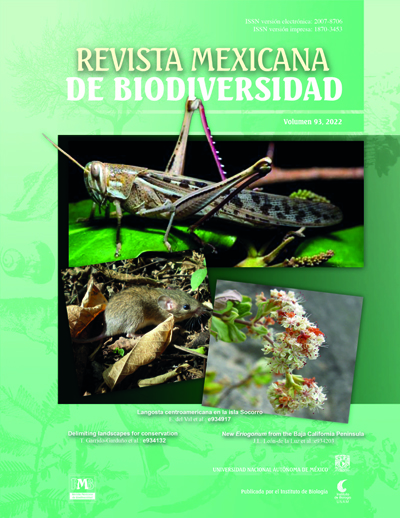


Defining environmentally heterogeneous sites when faced with conservation urgency and scarce in situ data
DOI:
https://doi.org/10.22201/ib.20078706e.2022.93.4132Keywords:
Biological conservation, Environmental heterogeneity, Structural connectivity, Heteromys pictus, Landscape matrix, Sampling designAbstract
We apply an environmental domains approach to identify environmentally heterogeneous characteristics defining a landscape matrix. We built environmental layers for national, regional, and local scales, considering the different scales studies can have. We used a numerical classification of explicit spatial layers and performed a multivariate classification. Based on the domains obtained, we mapped the landscape’s climatic heterogeneity and identified a comprehensive set of environmental variables that defined the landscape matrix at each scale. We specifically tested
our approach for its suitability to define a sampling strategy for a landscape genetics study, using as focal species the rodent Heteromys pictus. Namely, from the domains obtained at the local scale, we selected sampling localities that comprised the broadest habitat heterogeneity, which we corroborated in the field. The landscape matrix thus generated was used with genetic data previously obtained for H. pictus. Our approach allowed identification of environmental variables significantly associated with dispersal (gene flow) of H. pictus individuals in their natural habitat. We demonstrate its adequacy to efficiently determine sampling localities —or landscape sites— that encompass the highest environmental heterogeneity, in explored and unexplored landscapes, enabling rapid identification of localities and their environmental characteristics where in situ information is scarce.
References
Allendorf, F. W., Luikart, G., & Aitken, S. N. (2012). Conservation and the genetics of populations. London: John Wiley and Sons.
Austin, M. P., & Smith, T. M. (1989). A new model for the continuum concept. Vegetatio, 83, 35–47.
Balkenhol, N., & Fortin, M. J. (2015). Basics of study design: sampling landscape heterogeneity and genetic variation for landscape genetic studies. In N. Balkenhol, S. A. Cushman, A. T. Storfer, & L. P. Waits (Eds.), Landscape genetics: concepts, methods, applications (pp. 58–74). London: John Wiley and Sons.
Balkenhol, N., Cushman, S. A., Storfer, A. T., & Waits, L. P. (2015). Introduction. In N. Balkenhol, S. A. Cushman, A. T. Storfer, & L. P. Waits (Eds.), Landscape genetics: concepts, methods, applications (pp. 1–7). London: John Wiley and Sons.
Belbin, L. (1987). The use of non-hierarchical allocation methods for clustering large sets of data. Australian Computer Journal, 19, 32–41.
Belbin, L. (1992). Comparing two sets of community data: A method for testing reserve adequacy. Australian Journal of Ecology, 17, 255–262. https://doi.org/10.1111/j.1442-9993.1992.tb00807.x
Belbin, L. (1993). Environmental representativeness: regional partitioning and reserve selection. Biological Conservation, 66, 223–230. https://doi.org/10.1016/0006-3207(93)90007-N
Belbin, L. (1995). A multivariate approach to the selection of biological reserves. Biodiversity and Conservation, 4, 951–963. https://doi.org/10.1007/bf00058206
Borcard, D., Gillet, F., & Legendre, P. (2011). Numerical ecology with R. New York: Springer.
Challenger, A., & Soberón, J. (2008). Los ecosistemas terrestres. In Capital natural de México. Vol. I. Conocimiento actual de la bioiversidad (pp. 87–108). Mexico D.F.: Conabio.
Clarke, K. R. (1993). Non-parametric multivariate analyses of changes in community structure. Australian Journal of Ecology, 18, 117–143. https://doi.org/10.1111/j.1442-9993.1993.tb00438.x
Clarke, K. R., & Warwick, R. M. (2001). Change in marine communities: an approach to statistical analysis and interpretation. Plymouth, UK: PRIMER-E.
Cuervo-Robayo, A. P., Téllez-Valdés, O., Gómez, M. A., Venegas, B., Crystian, S., Manjarrez, J. F. et al. (2013). An update of high-resolution monthly climate surfaces for Mexico. International Journal of Climatology, 34, 2427–2437. https://doi.org/10.1002/joc.3848
DiBattista, J. D. (2008). Patterns of genetic variation in anthropogenically impacted populations. Conservation Genetics, 9, 141–156. https://doi.org/10.1007/s10592-007-9317-z
Ducci, L., Roscioni, F., Carranza, M. L., Agnelli, P., Russo, D., Frate, L. et al. (2019). The role of protected areas in preserving habitat and functional connectivity for mobile flying vertebrates: the common noctule bat (Nyctalus noctula) in Tuscany (Italy) as a case study. Biodiversity and Conservation, 28, 1569–1592. https://doi.org/10.1007/s10531-019-01744-5
Frankham, R. (2005). Conservation biology: ecosystem recovery enhanced by genotypic diversity. Heredity, 95,183. https://doi.org/10.1038/sj.hdy.6800706
Frankham, R. (2015). Genetic rescue of small inbred populations: meta‐analysis reveals large and consistent benefits of gene flow. Molecular Ecology, 24, 2610–2618. https://doi.org/10.1111/mec.13139
Foresta, M., Carranza, M. L., Garfì, V., Di Febbraro, M., Marchetti, M., & Loy, A. (2016). A systematic conservation planning approach to fire risk management in Natura 2000 sites. Journal of Environmental Management, 181, 574–581. https://doi.org/10.1016/j.jenvman.2016.07.006
García, E. (1998). Climas (Clasificación de Köppen, modificado por García). Escala 1:1000000. México D.F.: Conabio.
Garrido-Garduño, T., & Vázquez-Domínguez, E. (2013). Métodos de análisis genéticos, espaciales y de conectividad en genética del paisaje. Revista Mexicana de Biodiversidad, 84, 1031–1054. http://dx.doi.org/10.7550/rmb.32500
Garrido-Garduño, T., Téllez-Valdés, O., Manel, S., & Vázquez-Domínguez, E. (2016). Role of habitat heterogeneity and landscape connectivity in shaping gene flow and spatial population structure of a dominant rodent species in a tropical dry forest. Journal of Zoology, 298, 293–302. https://doi.org/10.1111/jzo.12307
GBIF.org (8 December 2016). GBIF Occurrence Download https://doi.org/10.15468/dl.nuohga
Gower, J. C. (1971). General coefficient of similarity and some of its properties. Biometrics, 27, 857–874.
Hall, L. A., & Beissinger, S. R. (2014). A practical toolbox for landscape genetic studies. Landscape Ecology, 29, 1487–1504. https://doi.org/10.1007/s10980-014-0082-3
Hidalgo-Galiana, A., Sánchez-Fernández, D., Bilton, D. T., Cieslak, A., & Ribera, I. (2014). Thermal niche evolution and geographical range expansion in a species complex of western Mediterranean diving beetles. BMC Evolutionary Biology, 14, 187. https://doi.org/10.1186/s12862-014-0187-y
Hoffmann, A. A, Sgrò, C. M., & Kristensen, T. N. (2017). Revisiting adaptive potential, population size, and conservation. Trends in Ecology and Evolution, 32, 506–517. https://doi.org/10.1016/j.tree.2017.03.012
Landguth, E. L., Fedy, B. C., Oyler-McCance, S. J., Garey, A. L., Emel, S. L., Mumma, M., et al. (2011). Effects of sample size, number of markers, and allelic richness on the detection of spatial genetic pattern. Molecular Ecology Resources, 12, 276–284.
https://doi.org/10.1111/j.1755-0998.2011.03077.x
Leathwick, J. R. (1998). Environmental correlates of tree alpha-diversity in New Zealand primary forest. Ecography, 21, 235–246.
Leathwick, J. R., Overton, J. M. C., & McLeod, M. (2003). An environmental domain classification of New Zealand and its use as a tool for biodiversity management. Conservation Biology, 17, 1612–1623. https://www.jstor.org/stable/3588909
Leigh, D. M., Hendry, A., Vázquez-Domínguez, E., & Friesen, V. (2019). Six percent loss of genetic variation in wild populations since the Industrial Revolution. Evolutionary Applications, 12, 1505–1512. https://doi.org/10.1111/eva.12810
Londoño-Murcia, M. C., Tellez-Valdés, O., & Sánchez-Cordero, V. (2010). Environmental heterogeneity of World Wildlife Fund for Nature ecoregions and implications for conservation in Neotropical biodiversity hotspots. Environmental Conservation, 37, 116–127. https://doi.org/10.1017/S0376892910000391
Manel, S., Schwartz, M., Luikart, G., & Taberlet, P. (2003). Landscape genetics: combining landscape ecology and population genetics. Trends in Ecology and Evolution, 20, 136–142. https://doi.org/10.1016/S0169-5347(03)00008-9
Melville, J., Haines, M. L., Hale, J., Chapple, S., & Ritchie, E. G. (2016). Concordance in phylogeography and ecological niche modelling identify dispersal corridors for reptiles in arid Australia. Journal of Biogeography, 43, 844–1855. https://doi.org/10.1111/jbi.12739
Metzger, M. J., Bunce, R. G. H., Jongman, R. H. G., Mucher, C. A., & Watkins, J. W. (2005). A climatic stratification of the environment of Europe. Global Ecology and Biogeography, 14, 549–563. https://doi.org/10.1111/j.1466-822X.2005.00190.x
Miles, L., Newton, A. C., Defries, R. S., Ravilious, C., May, I., Simon, B. et al. (2006). A global overview of the conservation status of tropical dry forests. Journal of Biogeography, 33, 491–505. https://doi.org/10.1111/j.1365-2699.2005.01424.x
Mimura, M., Yakahara, T., Faith, D. P., Vázquez-Domínguez, E., Colautti, R. I., Araki, H. et al. (2017). Understanding and monitoring the consequences of human impacts on intraspecific variation. Evolutionary Applications, 10, 121–139. https://doi.org/10.1111/eva.12436
Molina-Sánchez, A., Delgado, P., González-Rodríguez, A., González, C., Gómez-Tagle, A. F., & López-Toledo, L. (2019). Spatio-temporal approach for identification of critical conservation areas: a case study with two pine species from a threatened temperate forest in Mexico. Biodiversity and Conservation, 28, 1863–1883. https://doi.org/10.1007/s10531-019-01767-y
Morin, X., & Lechowicz, M. (2008). Contemporary perspectives on the niche that can improve models of species range shifts under climate change. Biology Letters, 4, 573–576. https://doi.org/10.1098/rsbl.2008.0181
Morrone, J. J. (2014). Biogeographical regionalisation of the Neotropical region. Zootaxa, 3782, 1–110. https://doi.org/10.11646/zootaxa.3782.1.1
Murphy, P. G., & Lugo, A. E. (1986). Ecology of tropical dry forest. Annual Review of Ecology and Systematics, 17, 67–88. https://doi.org/10.1146/annurev.es.17.110186.000435
Norman, J. A., & Christidis, L. (2021). A spatial genetic framework for koala translocations: where to? Wildlife Research, 48, 193–201. https://doi.org/10.1071/WR20055
Olson, D. M., & Dinerstein, E. (1998). The Global 200: A representation approach to conserving the Earth´s most biologically valuable ecoregions. Conservation Biology, 12, 502–515.
Oksane, J. (2015). Multivariate analysis of ecological communities in R: vegan tutorial. R package v.1.7 cc.oulu.fi/~jarioska/opetus/metodi/vegantutor.pdf
Parra-Quijano, M., Iriondo, J. M., & Torres, E. (2012). Ecogeographical land characterization maps as a tool for assessing plant adaptation and their implications in agrobiodiversity studies. Genetic Research of Crop Evolution, 59, 205–217. https://doi.org/10.1007/s10722-011-9676-7
Parusnath, S., Little, I. T., Cunningham, M. J., Jansen, R., & Alexander, G. J. (2017). The desolation of Smaug: The human-driven decline of the Sungazer lizard (Smaug giganteus). Journal for Nature Conservation, 36, 48–57. https://doi.org/10.1016/j.jnc.2017.02.002
Pauls, S. U., Nowak, C., Bálint, M., & Pfenninger, M. (2013). The impact of global climate change on genetic diversity within populations and species. Molecular Ecology, 22, 925–946. https://doi.org/10.1111/mec.12152
Pearce, J., & Lindenmayer, D. (1998). Bioclimatic analysis to enhance reintroduction biology of the endangered helmeted honeyeater (Lichenostomus melanops cassidix) in southeastern Australia. Restoration Ecology, 6, 238–243. https://doi.org/10.1046/j.1526-100X.1998.00636.x
Pereira, H. M., Ferrier, S., Walters, M., Geller, G. N., Jongman, R. H. G., Scholes, R. J. et al. (2013). Essential biodiversity variables. Science, 339, 277–278. https://doi.org/10.1126/science.1229931
Perktaş U., Peterson, A. T., & Dyer, D. (2015). Integrating morphology, phylogeography, and ecological niche modelling to explore population differentiation in North African common Chaffinches. Journal of Ornithology, 158, 1–13. https://doi.org/10.1007/s10336-016-1361-3
Quiroga, M. P., Castello, L., Quipildor, V., & Premoli, A. C. (2019). Biogeographically significant units in conservation: a new integrative concept for conserving ecological and evolutionary processes. Environmental Conservation, 46, 293–301. https://doi.org/10.1017/S0376892919000286
R Core Team (2015). R: A language and environment for statistical computing. R Foundation for Statistical Computing, Vienna, Austria. https://www.R-project.org/
Reed, D. H., & Frankham, R. (2003). Correlation between fitness and genetic diversity. Conservation Biology, 17, 230–237. https://doi.org/10.1046/j.1523-1739.2003.01236.x
Rzedowski, J. (1978). Vegetación de México. México D.F.: Limusa.
Sarre, S. D., & Georges, A. (2009). Genetics in conservation and wildlife management: a revolution since Caughlet. Wildlife Research, 36, 70–80. https://doi.org/10.1071/WR08066
Schoville, S., Bonin, A., Francois, O., Lobreaux, S., Melodelima, C., & Manel, S. (2012). Adaptive genetic variation on the landscape: methods and cases. Annual Review of Ecology and Systematics, 43, 23–43. https://doi.org/10.1146/annurev-ecolsys-110411-160248
Shaney, K. J., Díaz-Ramírez, L. G., Espíndola, S., Castañeda-Rico, S., Berovides-Álvarez, V., & Vázquez-Domínguez, E. (2020). Defining intraspecific conservation units in the endemic Cuban Rock Iguanas (Cyclura nubila nubila). Scientific Reports, 10, 21607. https://doi.org/10.1038/s41598-020-78664-w
Sneath, P. H. A., & Sokal, R. R. (1973). Numerical taxonomy. San Francisco: Springer.
Téllez-Valdés, O., & Dávila-Aranda, P. (2003). Protected areas and climate change, a case study of the cacti in the Tehuacán Cuicatlán Biosphere Reserve, México. Conservation Biology, 17, 846–853. https://www.jstor.org/stable/3095242
Téllez-Valdés, O., Farías, V., Aranda, P. D., Stein, J. L., Saade, R. L., & Botello, F. J. (2010). Mammalian diversity in climatic domains for Tehuacán-Cuicatlán Biosphere. Revista Mexicana de Biodiversidad, 81, 863–874. https://doi.org/10.22201/ib.20078706e.2010.003.656
Underwood, J. N., Wilson, S. K., Ludgerus, L., & Evans, R. D. (2013). Integrating connectivity science and spatial conservation management of coral reefs in north-west Australia. Journal for Nature Conservation, 21, 163–172. https://doi.org/10.1016/j.jnc.2012.12.001
Vázquez-Domínguez, E., Piñero, D., & Ceballos, G. (1998). Heterozygosity patterning and its relation to fitness components in experimental populations of Liomys pictus from tropical forests in western Mexico. Biological Journal of the Linnean Society, 65, 501–514. https://doi.org/10.1111/j.1095-8312.1998.tb01150.x
Vázquez-Domínguez, E., Piñero, D., & Ceballos, G. (1999). Linking heterozygosity, demography, and fitness of tropical populations of Liomys pictus. Journal of Mammalogy, 80, 810–822. https://doi.org/10.2307/1383250
Vázquez-Domínguez, E., Ceballos, G., & Piñero, D. (2002). Exploring the relation between genetic structure and habitat heterogeneity in the rodent Liomys pictus from Chamela, Jalisco. Acta Zoológica Mexicana-Nueva Serie, 86, 17–29.
Vega, R., Vázquez-Domínguez, E., White, T. A., Valenzuela-Galván, D., & Searle, J. B. (2017). Population genomics applications for conservation: the case of the tropical dry forest dweller Peromyscus melanophrys. Conservation Genetics, 18, 313–326. https://doi.org/10.1007/s10592-016-0907-5